Selected work
Poetry
Three poems chosen to show the collection’s range: the natural world, the next uncertain step, and the inheritance of home.

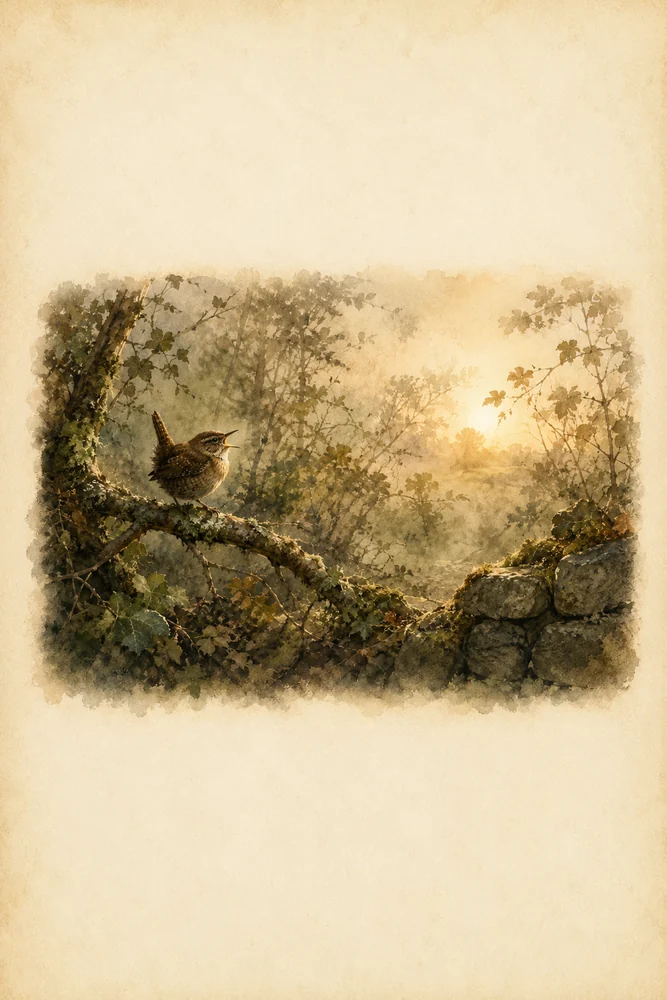
The Wren
Smallness, audacity, and a voice that fills the wood.
The Wren
Smallness, audacity, and a voice that fills the wood.
Small cathedral of the hedgerow,
brown as bark, as autumn earth,
as the underside of fallen log,
almost passing unnoticed —
yet sings.
God, how she sings.
Not gently, not by half,
not with the measured grace of larger things —
but full, and fierce, and flooding,
a voice that fills the hollow morning
as a river fills a valley:
without apology,
without restraint,
without the faintest knowledge
that she was not built for this.
They wrote her into legend once,
small queen of all the birds,
who rode the eagle’s back to heaven
and leapt, at the last,
a feather’s breadth above —
and won.
Not by force.
Not by size or span of wing.
But by the nerve to know
that audacity
is its own high ground.
I have watched her in the thicket,
brown dart between the branches,
quick as thought, as doubt, as joy —
never still enough to pity,
never small enough to overlook,
tail cocked like a dare
the morning has not answered.
What truth it holds to be
so entirely, unflinchingly —
here
to occupy a body small as rumour
and fill it past the brim?
There is a kind of power
that does not announce itself in size.
It lives in hedges.
It winters in the walls.
It tucks itself in ivy, stone, and shadow
and emerges, every morning,
to sing the darkness into lesser dark.
The cold does not silence her.
The frost does not diminish her.
January finds her in the hawthorn,
fierce and bright and indignant,
singing as though summer
owes her something —
and perhaps it does.
Perhaps we all do.
Little sovereign of the overlooked,
champion of the abundant small —
she needs no gilded plumage,
no height, no spectacle, no crown.
Her kingdom is the undergrowth.
Her throne the mossy stone.
Her anthem is the one song
that makes the whole wood
turn and listen,
and forget, for just a moment,
that the world is hard.
So sing.
Sing as if the sky requires it.
Sing as if the oak, planted deep
and patient as a promise,
has been waiting since its acorn
just to be the thing your voice
echoes off of.
Sing as the forgotten sing
when they remember they are not.
Sing as the waiting sing
when their time has finally come.
Sing as only she can sing —
with everything,
from nothing,
into all.
As Far as the Lamp
Courage as the deliberate taking of the next visible step.
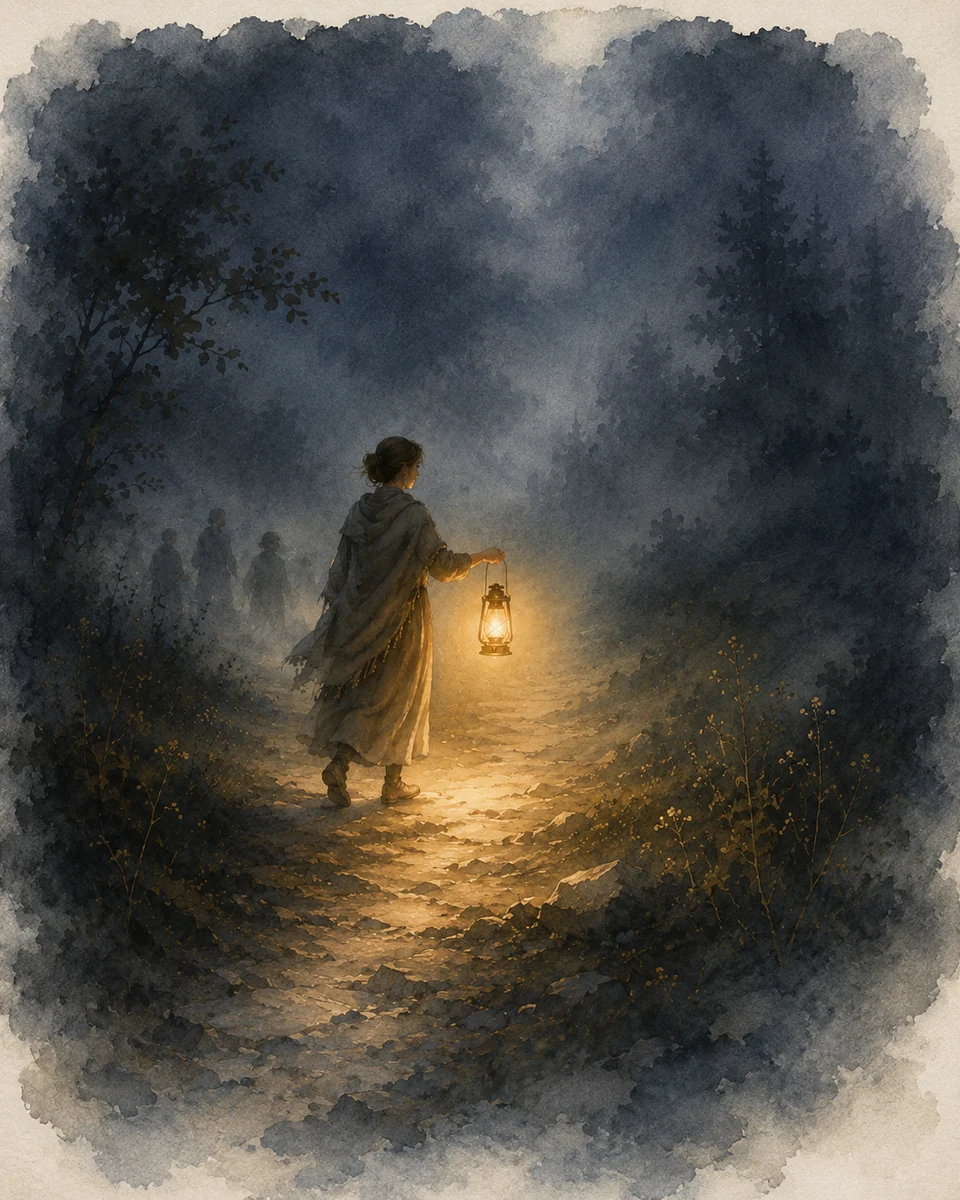
As Far as the Lamp
Courage as the deliberate taking of the next visible step.
The lamp throws light
an arm’s length down the road
and not one step beyond.
You have stood here a long time now,
waiting for it to reach further —
for the whole path to be given
before you agree to walk it.
It will not be given.
It never has been. Not to anyone.
The ones you think of as brave
saw exactly what you see:
a small gold circle on the ground,
the dark shut close behind,
the dark stood waiting up ahead,
and just enough light
to know where the next step falls.
So take it.
Not the leap — the leap is easy,
the leap is mostly panic
dressed as nerve.
Take the other thing,
the harder thing:
the slow and deliberate lowering
of your weight onto ground
you cannot promise will hold.
Test it. Feel it take you.
Then the next. And then the next.
This is courage with its eyes open.
This is precision in the fog —
not the wild rush forward
but the steady placing of a foot,
the hand kept firm although it shakes,
the refusal to look away
from a road you cannot see the end of.
And understand —
you were never walking it alone,
and never only for yourself.
Behind you, small and trusting,
someone is watching how it’s done,
learning from your back and shoulders
how a person moves
through what they cannot see.
You go first so the way is known.
You clear the branch. You mark the turn.
You press the unknown down
to something firmer underfoot,
one degree less frightening
for the ones whose feet
have not yet reached this ground.
So stop asking the road
to show you where it ends.
It will not answer. It never could.
Ask instead for the smaller mercy —
the strength to take the step
the lamp allows,
and then to trust the lamp
to travel with you.
The path is not out there,
finished, waiting to be found.
It is made of your walking.
And around the corner you cannot see,
there is another step,
and it is yours to take,
and it will hold.

What the Cabin Knows
Family, workmanship, inheritance, and the places that raise us.
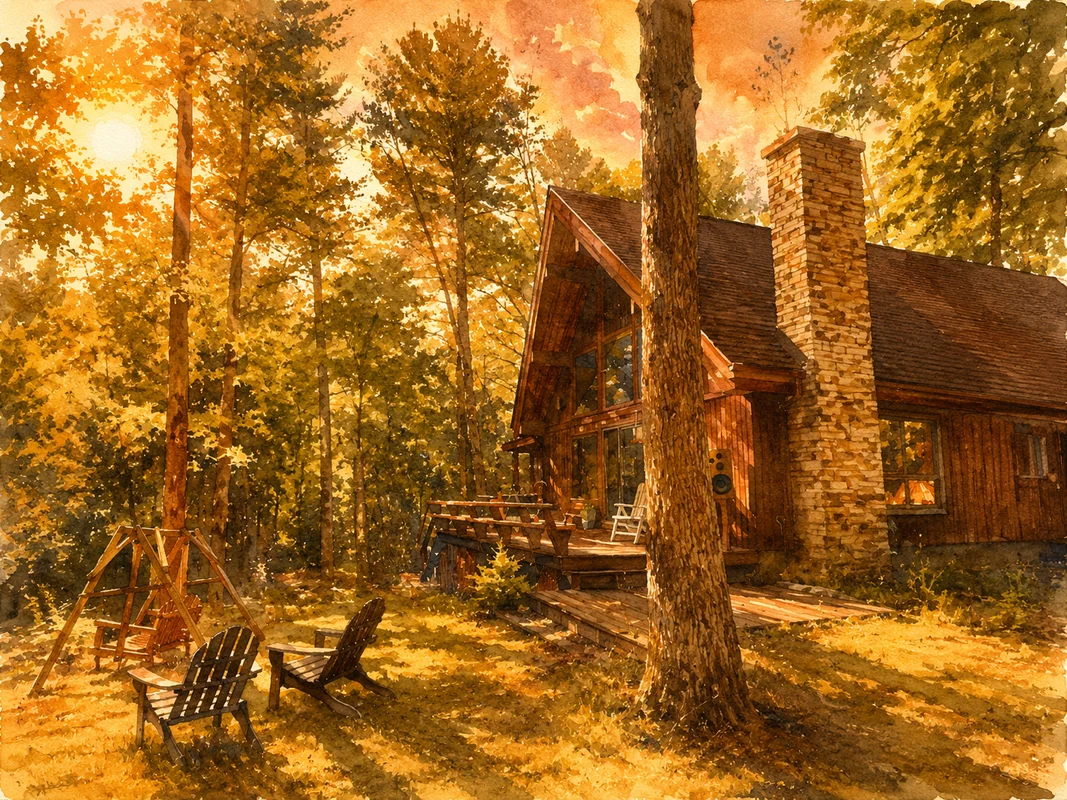
What the Cabin Knows
Family, workmanship, inheritance, and the places that raise us.
It rose from patience and the grain of pine,
raised by the family, hand to weathered hand,
someone forever sighting down a board for true,
where the white pines lean to listen,
and the stream gives back the morning in cold light.
They measured twice. They let the level speak.
Nothing was hidden in the way they joined it:
each corner square, each nail set flush and plain,
the honest weight of one beam trusting another.
That is the first thing that a house can teach —
that what you build to last, you build straight.
But it was never only walls they raised.
Inside those walls they raised the rest of us:
taught us the door swings out as well as in,
that a table grows the moment someone’s hungry,
that the warmest room is the one you make for others.
They hung no lesson on the wall in words.
It came in woodsmoke, in a hand held out,
in how they’d stop the jeep to watch a deer,
in how they’d name the birds and mean it kindly —
the wren, the eagle, and the woodpecker —
until we understood the land was kin.
Now the seasons turn the way they always turn:
the birch goes gold, the snow banks up the door,
and spring undoes it all and starts again.
We learned to love a thing we cannot keep,
which is, I think, the whole of love, and theirs.
So let it stand — the cabin and the life,
both raised the same, both meant to outlast weather.
The walls will hold their corners square for years;
and we will hold the harder things you built:
to keep a door thrown wide, a level true,
and love the world the way you taught us to.
All poems © James Reif. Please do not reproduce without permission.